How the Landfill Is Constructed
Liners & Leachate Collection Systems
The liner system for the TDS landfill was approved by the state, after a thorough examination and a contested case public hearing permitting process, in September 1990 and was designed to comply with the performance standard approach adopted by the EPA for the draft federal Subtitle D rule (Federal Register, Vol. 53, No. 168, Tuesday, August 30, 1988). The final federal rule, published on October 9, 1991 (Federal Register, Vol. 56, No.196, Wednesday, October 9, 1991), which went into effect two years later, continued to allow the performance based liner system that was a perfect match for the soil conditions at the TDS landfill and for the landfill design as permitted.
Liner system designs can be either prescriptive, in that they meet a design specified in the rules and regulations, or performance-based. It must be demonstrated that, at a minimum, contaminants from the landfill will not migrate outward beyond the bounds of the facility within its operating life and for 30 years thereafter. Even though the liner system at the TDS facility met the performance-based criterion without change from its original design, TDSL added a leachate collection system to its design for added environmental protection.
TDSL and its consultants successfully demonstrated that the natural gray unweathered Taylor Clay/Shale floor of the deep excavated landfill floor was even less permeable than mechanically recompacted clay, and that the combination of the unweathered clay floor, with a leachate collection system, and thick recompacted clay sidewall liners easily met the performance based landfill liner system currently required by both the EPA and the TCEQ. There are 500 feet of nearly impermeable soils between the landfill and the nearest underlying aquifer, and it is approximately 2,000 feet to any aquifer with usable water. Thus, the natural gray unweathered Taylor Clay/Shale serves as the bottom liner for the landfill, except where the extensive testing necessary by the state’s regulations indicate that a constructed liner of recompacted clay soils is required. The natural soils and groundwater conditions at the site allowed TDSL to obtain approval of its performance-based design.
The floor of the landfill is sloped toward one or more low areas so the leachate can be collected. For portions of the landfill excavated since federal EPA Subtitle D rules became effective, a leachate collection system has been and will be installed. The leachate collection system consists of trenches filled with chipped tires or gravel around the perimeter of the landfill and spaced at regular intervals across the floor of the landfill. The design of the leachate collection system is based on time-proven empirical relationships developed for agricultural drainage. The perimeter trenches can intercept any leachate that migrates down the sidewalls of the landfill. The trenches on the floor of the landfill prevent leachate from collecting more than a foot or so above the floor of the landfill and channel the leachate to central collection points.
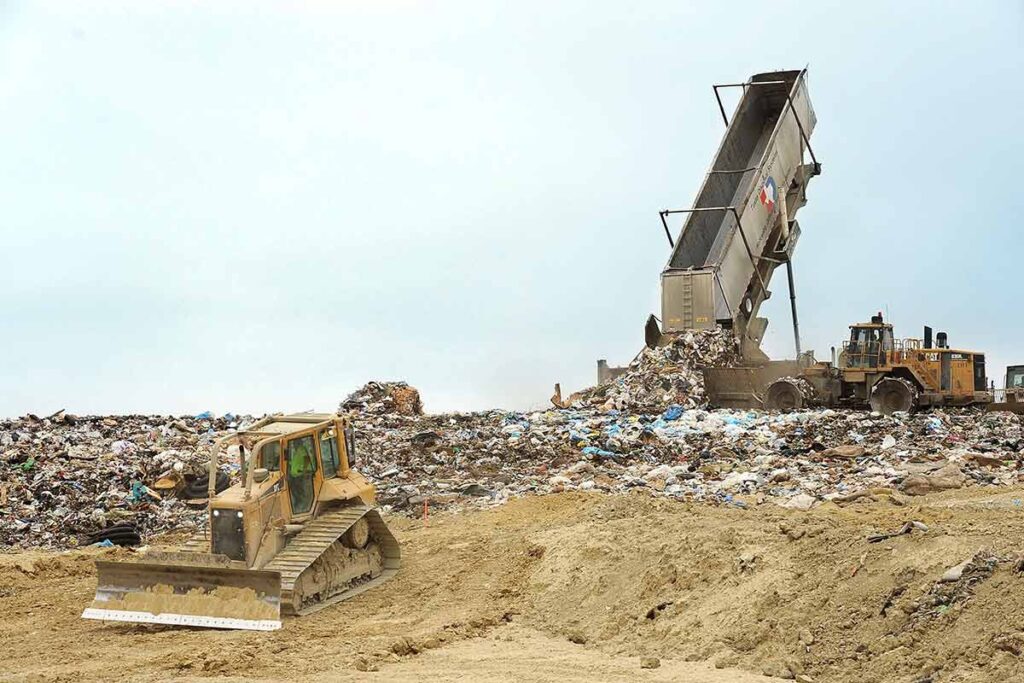
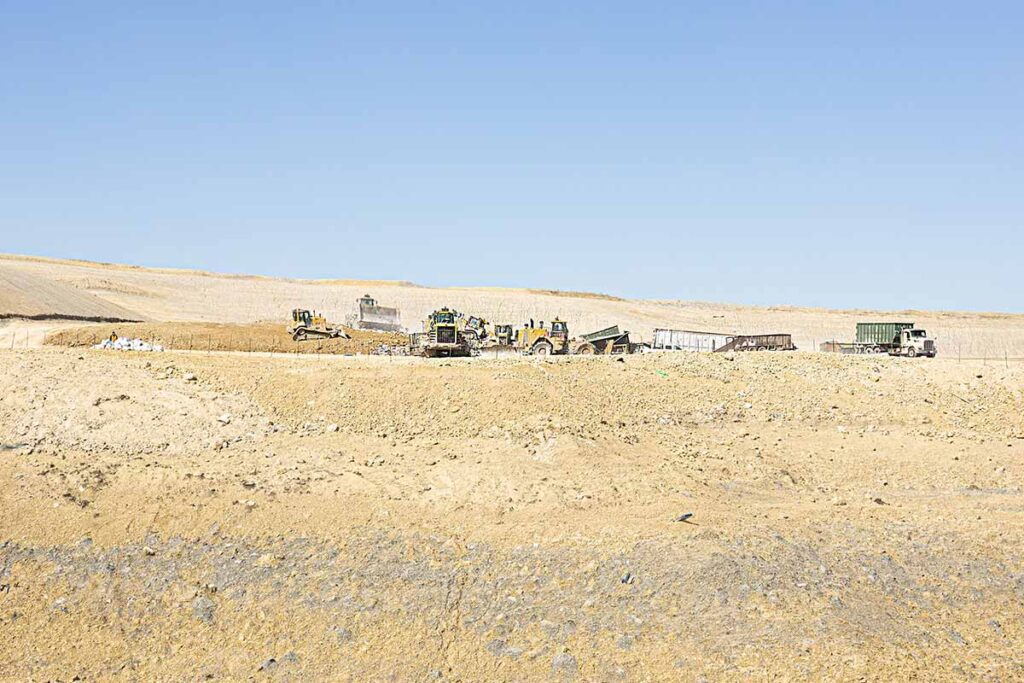
The sidewalls of the landfill are constructed with moisture and clod sized controlled mechanically recompacted clay and are a minimum of eight feet thick. The sidewalls separate the waste disposed at the facility from shallow groundwater that occurs below the ground surface in the natural cracks and fissures of unweathered Taylor Clay that constitutes the surface soil and subsoil at the landfill site. The design of the landfill requires excavation into the unweathered Taylor Clay/Shale so that the floor of the landfill is completely beneath the shallow groundwater. Thus, any fluids accumulating in the landfill or generated by the decomposition of the contained waste cannot escape into this shallow groundwater even if the liner system fails, but can be removed through the leachate collection system and treated or evaporated in an approved composite-lined pond located on site.
Groundwater and Methane Monitoring Systems
The groundwater monitoring system is designed to intercept groundwater that might leave the site in the unlikely event of a release from the landfill. A release is unlikely because the floor of the landfill is below the base of the shallow groundwater in the unweathered Taylor Clay/Shale. Additionally, the leachate collection system prevents fluid levels in the landfill from rising above the base of the shallow groundwater, the sidewall liners are a minimum of eight feet thick, and the shallow groundwater exerts an inward hydraulic pressure such that it tends to move inward toward the landfill, not outward.
The groundwater monitoring wells were sited with consideration of potential flow directions before and after landfill construction, the configuration of the floor and sidewalls of the landfill, and the configuration of the base of the shallow groundwater at the weathered/unweathered Taylor Clay/Shale interface. Monitoring wells, which were installed before the federal Subtitle D rule became effective, met the new criteria. Background water quality sampling in accordance with the approved Groundwater Sampling and Analysis Plan is in progress. Additional groundwater monitoring wells will continue to be installed as the landfill expansion takes place and as stipulated in the current TDSL permit.
Gas monitoring wells also have been installed in accordance with the approved plan. These were installed recognizing that the potential gas migration routes will be above the shallow groundwater table. The wells are spaced at regular intervals along the property line where landfilling is occurring and has occurred, and have been installed along pipeline easements as required. Landfill gas has not been detected in any gas monitoring well to date.